



Reads the log
Uses the data your setup already produces.
Start to finish in one workflow—not a throwaway starter map.
Baseline. VE, lambda, spark from physics.
Refinement. Logs: commanded vs actual lambda, airflow vs model—VE, trim, spark.
Tuned. Confirmed on the car.
Create an account and start a plan (DIY monthly includes a 7-day trial) to add vehicles and run reports.
Analysis
Pull #12 · WOT hit
Vehicle profile
1969 Camaro
502cid · Holley Dominator · E85
AI-assisted read
Likely issue
Lean spike post-shift
Confidence
78%
Recommended next checks
The full arc
Physics-first baseline when you need it—VE, lambda, spark—or start from CSV logs and refine commanded vs actual lambda and airflow vs the model into VE, trim, and spark you re-log to confirm. Goal: tuned, not just started.
Combo profile → baseline math
Structured setup grounds VE, lambda, spark, and startup strategy in your hardware—not a generic basemap thread.
Datalogs → corrections
Upload CSVs from your ECU toolchain; we align channels to what the car actually did and suggest VE, fuel trim, and spark moves with clear verification steps.
Tuned
When the data and the seat-of-the-pants agree, you are done—not when the starter map merely lights the engine.
Create an account and choose a plan to save vehicles and run reports.
Assistance only — verify on the car and follow your ECU manufacturer’s guidance.
Overview
We are built around two kinds of truth: math that gets you in the ballpark, and data that finishes the job. Start from a deterministic baseline or jump straight to logs—either way the product pushes you toward the same outcome: a calibration that matches the real engine.
VE from the engine model, lambda targets from fuel and load, and a conservative spark curve—so the first pull is grounded in physics, not vibes.
Stack datalogs and close the gap: commanded vs actual lambda, airflow vs prediction—then VE, fuel trim, and spark optimization with clear next checks.
Not another “step”—the outcome. A map state that keeps improving with each verified pass until the car and the data agree.
Same pipeline for your garage project or a shop that lives in CSV exports every week.
Not just another chatbot
Generic AI chatbots generate text about tuning. Crazy Tuner calculates your tune from physics — ideal gas law, fuel stoichiometry, injector dynamics, and thermodynamics — then uses AI to interpret your build and explain what to check.
Generic AI chatbots
ChatGPT, Grok, Gemini, etc.
"Give me a VE table for my LS turbo on E85" → you get a wall of text with numbers that look right but were never calculated from anything real.
Crazy Tuner
Deterministic math + AI
Same LS turbo on E85 → you get a VE table, lambda target, and spark map calculated from your bore, stroke, cam duration, injector size, and boost target. Every cell traces back to a formula.
Physics-first
Engine math from your combo through maps, with safety checks — runs automatically in the product, not as a long manual checklist.
0 hallucinated
cells — every value is calculated, not predicted
Your build
not a generic LS/Coyote/2JZ template
Aftermarket tuning can turn into a cycle of log review, repeated revisions, and expensive trial and error.
DIY builders often know enough to work on their own car, but not enough to always know the next best move with confidence.
Shops and professional tuners often know exactly what they are doing, but still lose time to repetitive log review and manual diagnostics.
Crazy Tuner helps both groups move from baseline to refinement to a tune they can stand behind—without drowning in noise.
Without Crazy Tuner
With Crazy Tuner
Crazy Tuner pairs a physics engine for the baseline with an AI copilot for the refinement loop—so you always know whether the next move is about the model, the sensors, or the tables.
Uses the data your setup already produces.
Considers engine, fuel system, drivetrain, and intended use.
Shows what likely happened, why it matters, and what to check next.
Workflow
Two engineering phases—math first, then your datalogs—with tuned as the finish line, not a mystery step three weeks later.
Math and physics
You: Save your combo profile (engine, ECU, fuel, goals). New build? Generate a base-tune guide. Already running a map? You can skip straight to logs—same vehicle context either way.
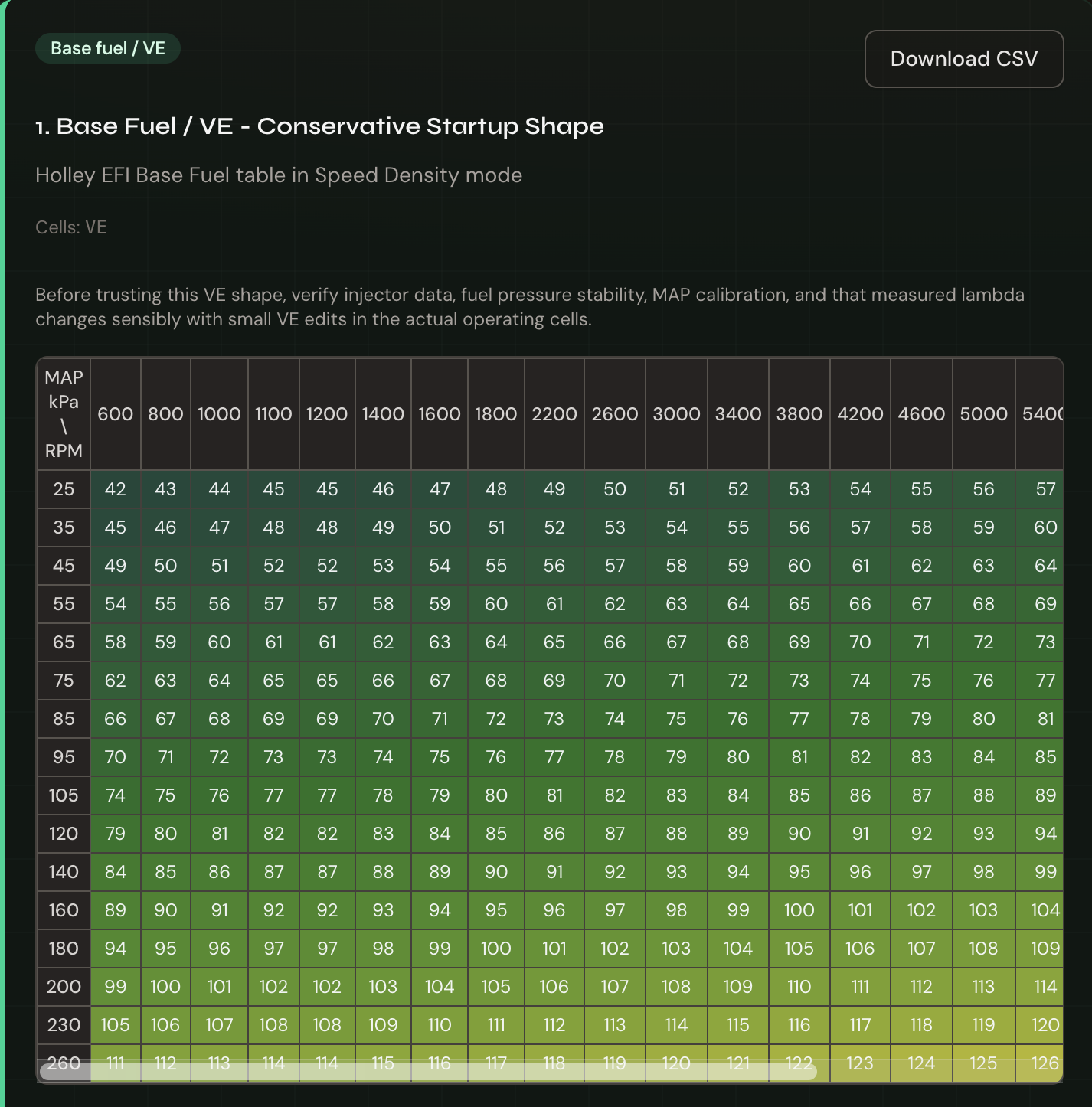
Crazy Tuner: We derive a VE table from the engine model, lambda targets from fuel type and load, and a conservative spark curve—plus startup strategy and a first-start checklist—so the car has a defensible starting point before you chase edge cases.
Data from the car
You: Export CSV datalogs after each session. Read the report, make careful table changes in your ECU software, and re-log until the errors you care about shrink.
Crazy Tuner: We line up commanded lambda vs actual, airflow vs what the model predicted, and surface where VE, fuel trims, or spark should move—with confidence, reasoning, and map-state updates so every pass builds on the last.
Not “step 3”—the outcome
When the commanded and measured stories agree, drivability feels right, and you trust the margins—that is tuned. Crazy Tuner is built to keep you in that loop until you get there, not to drop you off after a starter map.
DIY
For capable enthusiasts who want guidance, diagnostics clarity, and smarter recommendation support without paying for endless revisions.
See pricingProfessional
For professionals who want faster log triage, less repetitive diagnostics, and a more efficient tuning workflow.
See pricingCrazy Tuner is designed to improve decision-making, not blindly make risky changes.
Crazy Tuner is starting with a focused launch and expanding into broader performance workflows over time. Roadmap priorities follow customer demand for additional ECU export formats, shop collaboration features, and tighter integration with how professional tuners already work in the garage and on the dyno.
Two simple subscriptions: DIY and Professional. Each includes a monthly report allowance (base tune or log analysis). If you hit the cap before the month resets, add prepaid reports from billing—Professional includes a higher allowance for busy calibrators.
$25/mo or save 15% yearly. DIY monthly includes a 7-day trial before you are billed. Same Holley, MoTeC, Haltech, FuelTech, and HP Tuners CSV workflow—throttled by fair monthly usage, not confusing pack ladders.
$200/mo or save 15% yearly with a much higher included monthly allowance. Built for throughput, customer handoffs, and teams that live in logs every week.
Builders and shops use the same pipeline: defensible starting maps when you need them, structured log review when the car is lying to the model, and a map state that improves until you are done—not until you “got it running.”
Sign up with email, add a vehicle profile, then run a guided base tune, jump straight to CSV log analysis, or alternate between both as the combo evolves. Questions on usage, safety, or billing are on the FAQ and pricing pages.